
Hair Extensions for Short Hair: What You Need to Know Before You Book

Short hair can be beautifully extended, but it needs a very considered approach. The shorter the natural hair, the more each detail matters: the method, the placement, the weight, the colour blend, the cut and the strength of the client’s own hair.
For some clients, extensions can add length, volume and softness to a shorter style. For others, the safest advice may be to wait until the natural hair has grown a little more, or to choose a more subtle result first.
At Premium Hair Extensions by Lavinia, clients across London, Essex, Thurrock and the surrounding areas often ask the same question: can you fit hair extensions for short hair and still make them look natural? The honest answer is yes, sometimes, but not always in the way people expect.
There is no single “best” method for everyone. The right choice depends on your natural hair length, thickness, density, condition, haircut and desired finish.
Can hair extensions be fitted to short hair?
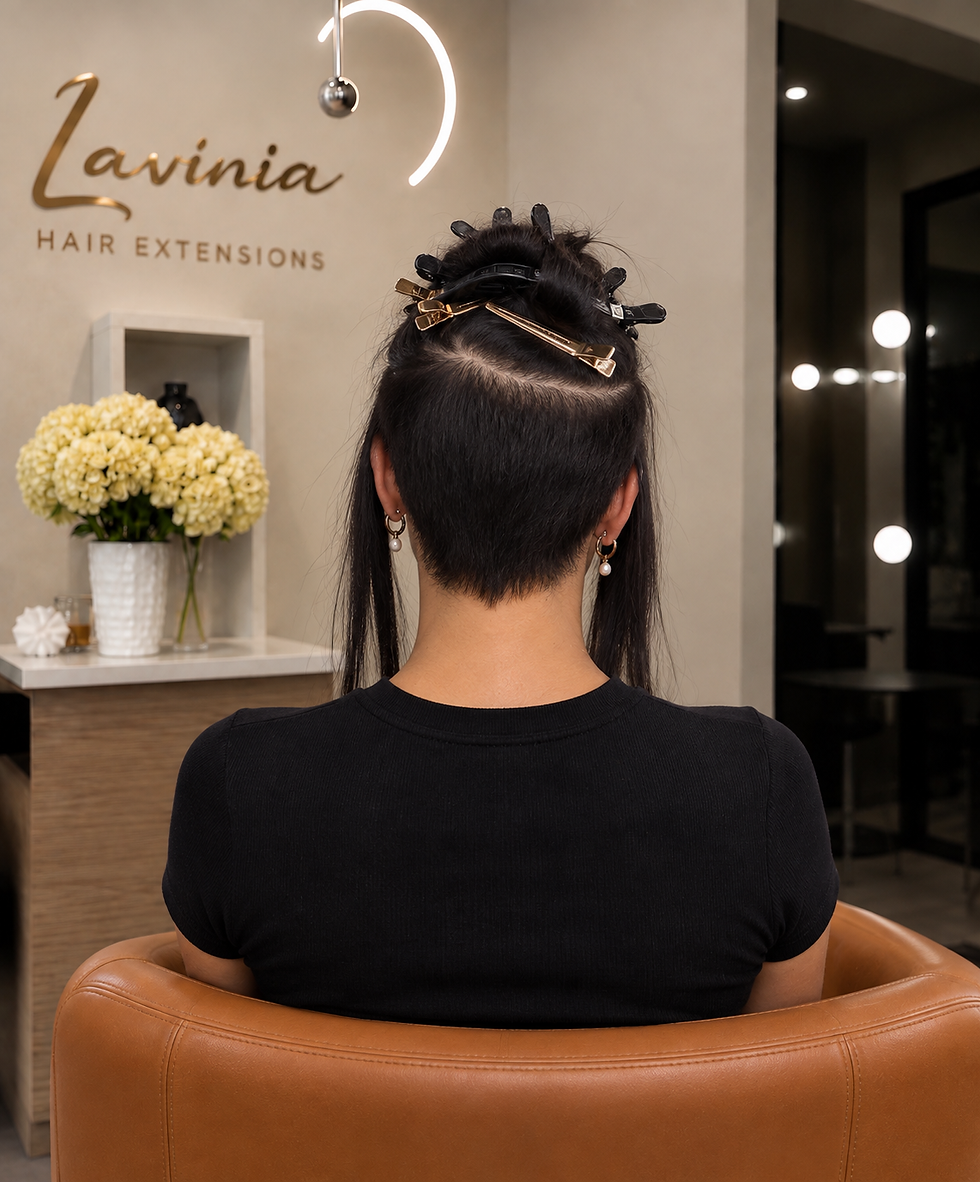
Extensions can be fitted to shorter hair when there is enough natural hair to cover the attachment points and support the added hair safely. The natural hair also needs enough length to blend with the extensions once they are cut and shaped.
This is where short hair becomes more complex than mid-length or long hair. Extensions do not simply attach and disappear. The bonds, tapes, rings, wefts or strands need to sit discreetly within the hair, without showing when the hair moves or when it is styled.
A professional fitter will look at several things before deciding whether extensions are suitable:
The current length of the natural hair
The thickness and density through the sides, crown and nape
The strength and condition of the hair
The shape of the haircut
Any layers, graduation or blunt lines
The colour placement and root depth
The client’s styling habits
The length and volume the client wants to achieve
Short hair extensions can be very successful when these details are assessed properly. They can look heavy, visible or uncomfortable when they are not.
How short is too short for extensions?
There is no universal minimum length that applies to every client, every method or every head of hair. Suitability depends on how the hair behaves, not just how long it measures.
Very cropped hair, tight pixie cuts and hair that is extremely short around the sides or nape are often too short for traditional extensions. In these cases, there may not be enough hair to hide the attachments or create a believable blend.
Hair that is short but has some weight, movement and coverage may offer more possibilities. For example, a grown-out bob, a longer pixie, or a short layered cut with enough density may be assessed for certain methods. Even then, the result must be planned carefully.
The key question is not only “can extensions be attached?” It is also:
Will they be safe, comfortable and natural-looking once fitted?
If the natural hair cannot cover the attachment points, the extensions may show. If the natural hair is too weak, the added weight may put pressure on it. If the cut is very blunt or short, the join between natural hair and extensions may be obvious unless the hair is expertly blended.
A consultation is the safest way to decide. Photos can be helpful, but an in-person assessment gives a much clearer view of the hair’s true density, texture, condition and movement.
What happens when extensions are fitted to short hair?
When extensions are fitted to short hair, the natural hair does not disappear. It sits over, around and between the extension hair. This means the original haircut still affects the final result.
If the natural hair is very blunt, the line can remain visible over the longer extensions. If the top layers are short, they may need soft shaping so they sit more naturally with the added length. If the sides are fine, attachments may need to be smaller, lighter or avoided in certain areas.
A beautiful result comes from balance. The extensions need to add enough hair to create shape, but not so much that they overwhelm the natural hair.
For shorter hair, a specialist will pay close attention to:
Sectioning Clean, controlled sections help the extensions sit securely and evenly.
Placement Extensions must be positioned where they can be hidden and where they will move naturally.
Weight The strand or weft weight must suit the strength of the natural hair.
Strand selection Smaller or more discreet strands may work better in certain short or finer areas.
Cutting and blending The final cut is just as important as the fitting. Without it, extensions can look separate from the natural hair.
This is why professional hair extensions are not simply about choosing a method. The artistry is in the planning and finishing.
Which extension methods may suit shorter hair?
Premium Hair Extensions by Lavinia offers several professional methods, including Tape-In, Keratin Bonds, Micro Keratin, Micro Rings, Nano/I-Stick and LA Weave. Each has its place, but not every method is suitable for every type of short hair.
A consultation will determine which, if any, is appropriate.
Tape-In extensions
Tape-In extensions can create a soft, flat finish because the attachment lies close to the head. They are often chosen for clients who want volume, length or both.
For shorter hair, Tape-Ins may be suitable when there is enough natural hair to conceal the tapes. They may not be ideal where the hair is very short, sparse or heavily layered in areas where the tapes would sit.
The placement must be carefully planned so the tapes do not show when the hair moves, especially around the sides, crown and hairline.
Keratin Bonds
Keratin Bonds are applied as individual strands, which allows for more tailored placement. This can be useful when working with shorter hair because the fitter can adjust the size, position and distribution more precisely.
They may work well when the natural hair has enough coverage and strength to support the bonds. For very short or fragile hair, they may not be suitable, or a smaller, more delicate approach may be needed.
The result depends heavily on expert sectioning, correct bond size and a natural colour blend.
Micro Keratin extensions
Micro Keratin uses smaller bonds than standard keratin applications. This can be helpful for finer areas or shorter hair where discretion is important.
Because the bonds are smaller, they may sit more subtly in certain placements. That does not mean they are suitable for all short hair. The natural hair still needs to be long and strong enough to cover and support them.
Micro Keratin can be a refined option when the goal is a discreet, tailored finish rather than excessive length or weight.
Micro Rings or I-Tip extensions
Micro Rings, also known as I-Tip extensions, are fitted using small rings rather than heat or adhesive. They offer individual strand placement, which can be useful for building shape and volume.
For shorter hair, the rings must be hidden well. If the hair is too short or too fine in the fitting area, they may become visible or feel uncomfortable. The natural hair also needs enough strength to hold the strand safely.
This method may suit some clients, but it requires careful assessment of density, especially around the sides and upper layers.
Nano or I-Stick extensions
Nano or I-Stick extensions use very small attachment points. Their discreet size can make them appealing for clients with finer hair or those needing more subtle placement.
For shorter hair, this smaller attachment can sometimes be an advantage, particularly where standard-sized attachments would be too visible. Still, the method is not automatically suitable. The hair must be long enough to conceal the attachments and strong enough to carry the extensions.
Nano fitting requires precision. Poor placement or too much weight can affect comfort and the natural appearance of the result.
LA Weave
The LA Weave can add volume and length with wefts of hair fitted in rows. It can be a lovely option for certain clients, especially where there is enough natural hair to cover the rows.
For very short hair, an LA Weave may not be the best choice because the weft needs coverage and support. If the top layers are too short or the hair is fine around the crown, the weft may show.
This method is usually considered when the natural hair has sufficient density and length to hide the rows and blend with the added hair.
How to achieve a natural blend with short hair

A natural-looking blend is one of the biggest challenges with extensions for short hair. Shorter cuts often have clear shape, strong edges or shorter top layers. If longer hair is added without refining that shape, the result can look disconnected.
A good blend usually involves several steps.
Choose a realistic length
Going from very short hair to very long hair can be difficult to disguise. In many cases, a more moderate length looks softer and more believable, especially for a first fitting.
The aim is to create hair that looks like it could naturally belong to the client. Sometimes that means adding volume and a little length first, then moving longer at a future appointment as the natural hair grows.
Match colour with precision
Colour matching is essential. With short hair, the natural hair sits visibly over the extensions, so any mismatch is easier to spot.
A specialist may blend multiple shades to reflect the natural tones in the hair, rather than using one flat colour. This is especially useful for blondes, balayage, highlighted brunettes and dimensional colours.
Cut the extensions into the natural hair
The fitting is only part of the service. The cut after fitting creates the final shape.
Short natural hair may need to be softened, layered or blended so it sits naturally with the extensions. This should be done carefully, without removing the fullness needed for the finished look.
Respect the natural hairline
Extensions should not be placed too close to the visible hairline, parting or areas that move frequently. On short hair, these areas are more exposed.
Good placement allows the hair to be worn comfortably and styled without obvious attachments.
Why hair condition matters so much
Extensions should never be fitted simply because a client wants them. The natural hair must be able to support them.
If hair is weak, over-processed, breaking, thinning or shedding heavily, adding extensions may not be advisable straight away. The safest plan may involve improving the condition first, choosing a lighter result, or avoiding certain methods.
A professional consultation should include an honest discussion about hair health. This protects both the natural hair and the final finish.
Signs that extra care may be needed include:
Breakage around the hairline or crown
Very fine or sparse areas
Recent chemical damage
Excessive shedding
Hair that feels brittle or stretchy
Scalp sensitivity
Uneven density from previous extensions or styling stress
This does not always mean extensions are impossible. It means the method, amount of hair and placement need to be chosen with care.
Common mistakes when choosing extensions for short hair
Many disappointing results come from choosing an extension method before properly assessing the hair.
Some of the most common mistakes include:
Choosing the longest length possible when a softer length would blend better
Selecting a method because it is popular rather than suitable
Adding too much hair for the natural hair to support
Ignoring short layers around the crown or sides
Placing extensions too high or too close to the hairline
Skipping maintenance appointments
Expecting extensions to hide an unsuitable haircut without blending
Fitting extensions to damaged hair without addressing condition first
The phrase best hair extensions for short hair is searched often, but the most accurate answer is personal. The best method is the one that suits the individual head of hair in front of the specialist.
What to expect during a professional consultation
A consultation for short hair should feel calm, detailed and honest. It is the point where the desired look meets what the natural hair can safely achieve.
At Premium Hair Extensions by Lavinia, a consultation may include discussion around:
Your current hair length, cut and density
The condition of your natural hair
Any colour history or chemical treatments
Your ideal result for length, volume and shape
Suitable methods, and methods that may not be advised
Colour matching and shade options
How much hair may be needed for a balanced finish
Maintenance, aftercare and styling expectations
Whether it is better to proceed now or allow more growth first
For clients comparing hair extensions London or hair extensions Essex services, this level of assessment is especially important. Short hair requires experience, patience and a method chosen for the client, not a standard approach.
A good consultation should never pressure you into a method. It should help you understand your options clearly.
Aftercare and maintenance for shorter hair extensions
Aftercare matters for all extensions, but it is especially important when the natural hair is shorter. Because the blend is more precise, poor aftercare can make attachments more visible, disturb the shape or place stress on the natural hair.
Your aftercare advice should be tailored to your chosen method, but general principles often include:
Brushing gently with the correct extension-friendly brush
Supporting the attachment area while brushing
Avoiding pulling or rough handling
Keeping oils and heavy conditioners away from attachment points where advised
Drying the roots and attachment areas properly
Sleeping with the hair secured loosely to reduce tangling
Attending maintenance appointments on time
Avoiding excessive heat near bonds, tapes or rings unless advised safe for your method
Shorter natural layers can sometimes flick out or separate from the extensions between washes. Styling may be needed to keep the blend polished. Your specialist should show you how to manage this at home without putting stress on the hair.
Maintenance appointments are also essential. As natural hair grows, attachments move down. On shorter hair, this can affect both visibility and comfort sooner than expected if appointments are missed.
Extensions can add length, volume and shape with the right plan

Extensions for short hair are not only about creating long hair. In many cases, the most elegant results come from adding shape, fullness and softness.
They can help:
Fill out fine or sparse ends
Soften a shorter cut while it grows
Add body around the sides
Create a fuller bob or lob shape
Add length gradually
Improve balance after an uneven cut, where suitable
The most natural results are often the most considered ones. They do not rely on excessive hair or dramatic length. They rely on correct method choice, careful placement, beautiful colour matching and a cut that brings everything together.
The right method is chosen after seeing your hair
Hair extensions for short hair can look discreet, polished and beautifully blended when the natural hair is suitable and the fitting is planned properly. They can also be the wrong choice if the hair is too short, too fragile or unable to conceal the attachments.
That honesty matters.
Premium Hair Extensions by Lavinia offers Tape-In, Keratin Bonds, Micro Keratin, Micro Rings, Nano/I-Stick and LA Weave methods, but the recommendation will always depend on the individual client. The safest, most natural result comes from matching the method to the hair, not forcing the hair to suit a method.
If you are considering short hair extensions in London, Essex, Thurrock or nearby areas, the best next step is a professional consultation. Premium Hair Extensions by Lavinia can assess your natural hair, talk through realistic options and advise whether extensions are suitable for the result you have in mind.


